Manufacturer and Exporter of Sintered Bronze Filter Elements
The best Manufacturer of Sintered Bronze Silencer in Pune, India
Industrial gas may look clean, but what travels through a pipeline is not always just gas.
Small liquid droplets, moisture, oil mist and solid contaminants can travel along with compressed air and other process gases. Once these contaminants reach regulators, valves, instruments or other sensitive equipment, they can affect performance and increase maintenance requirements.
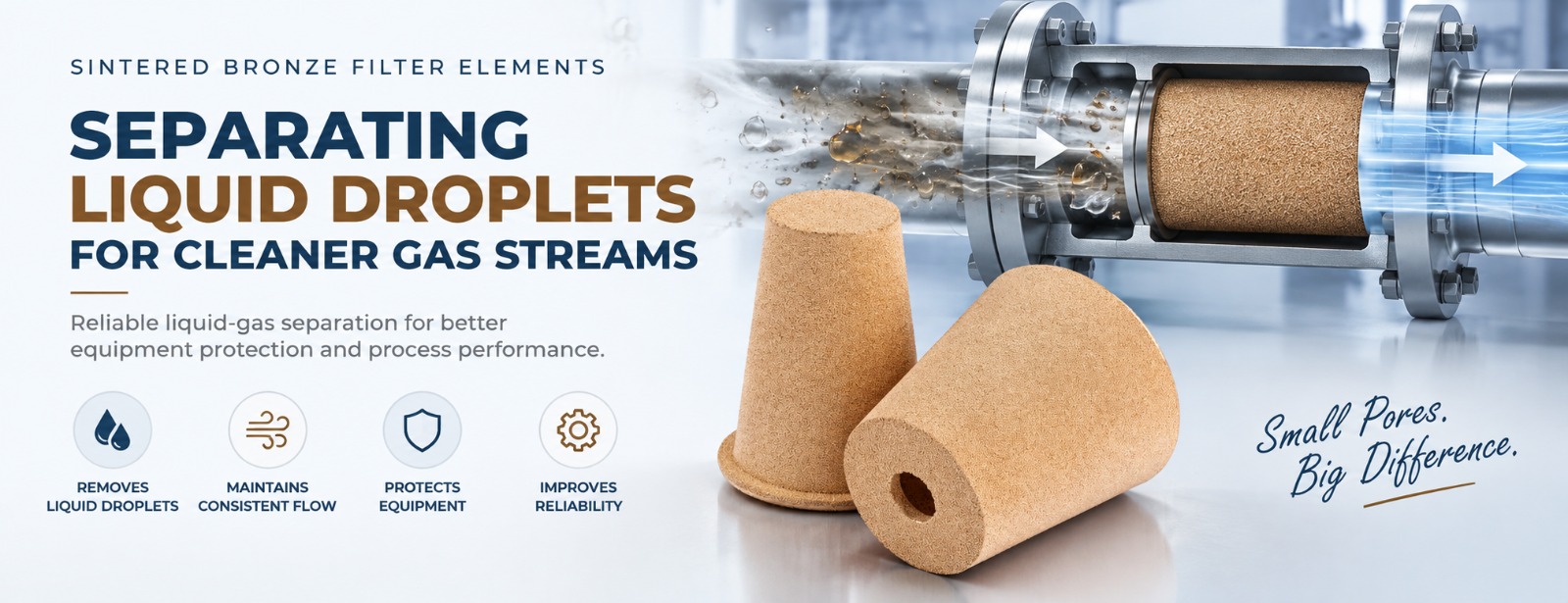
This is where Sintered Bronze Filter Elements for liquid-gas separation can play an important role.
The interconnected porous structure of sintered bronze allows gas to pass through while helping remove unwanted contaminants from the stream. Combined with mechanical strength, controlled porosity and reusable construction, this makes sintered bronze useful for demanding industrial filtration applications. Satkirti provides a range of sintered filters for industrial filtration requirements.
Let's understand how the process works and why choosing the right filter element matters.
Liquid contamination can enter a gas system in several ways.
In compressed-air systems, atmospheric moisture enters with the intake air. Compression and subsequent cooling can cause some of this moisture to condense.
Oil aerosols may also be present in certain systems, while process gases can carry droplets generated elsewhere in the equipment.
As a result, the gas stream can contain a mixture of:
These contaminants may be very small, but their effect on downstream equipment can become significant over time.
Allowing moisture and other liquid contaminants to continue downstream can create several problems.
Moisture may contribute to corrosion inside pipelines and equipment. Oil or liquid contamination may interfere with instrumentation and process quality. Contaminants can also accumulate inside narrow passages, regulators and valves.
Depending on the system, this can contribute to:
Removing contamination before it reaches critical equipment therefore helps improve overall system reliability.
A Sintered Bronze Filter Element is a porous metallic filtration component manufactured using powder metallurgy.
Bronze powder is formed into the required shape and then sintered under controlled conditions. During sintering, the particles bond together while leaving a network of interconnected pores throughout the element.
These pores form the filtration pathways.
Instead of gas simply flowing around a screen or surface, it travels through this porous metallic structure.
The result is a filter element that combines:
Satkirti manufactures Sintered Bronze Filter Elements for different air, gas, liquid and industrial filtration requirements.
The basic principle is easy to understand.
Imagine a gas stream carrying tiny droplets of moisture.
When the contaminated gas reaches the Sintered Bronze Filter Element, it must travel through a network of small interconnected passages.
The gas can continue through the porous structure. Liquid droplets and other contaminants interact with the filter structure rather than simply travelling freely downstream.
Depending on the droplet size, operating conditions, element design and filtration requirement, droplets can be intercepted and collected within or on the porous media.
The separated liquid can then be removed or drained according to the design of the filtration assembly.
In simple terms:
Contaminated gas enters → gas passes through porous bronze → contaminants are separated → cleaner gas continues downstream.
This combination of filtration and controlled gas flow is what makes porous sintered media useful in many industrial systems.
One of the most important characteristics of a sintered filter is its porosity.
If the pore structure is inconsistent, gas may preferentially travel through larger pathways. That can make filtration performance less predictable.
A properly manufactured Sintered Bronze Filter Element has a controlled interconnected pore structure.
This helps provide more consistent:
Satkirti's sintered filters are manufactured through controlled powder-metallurgy processes to provide the required porous structure for industrial applications.
A filter needs to remove contamination, but it must also allow sufficient gas to pass through.
This creates an important engineering balance.
If filtration is unnecessarily fine for the application, resistance can increase. If filtration is too coarse, the required contaminant removal may not be achieved.
The correct filter should therefore balance:
Filtration requirement + flow rate + pressure drop + contaminant loading.
This is especially important in gas systems where stable downstream flow is necessary for valves, instruments and process equipment.
It is one reason filter selection should not be based only on micron rating.
Compressed air can carry moisture, oil and solid contamination.
Sintered bronze elements can form part of filtration arrangements designed to improve compressed-air cleanliness before the air reaches downstream pneumatic components.
Process gases may require particulate and liquid contamination control before entering regulators, instruments or other equipment.
Pressure regulators contain relatively small internal passages and precision components. Cleaner gas can help maintain reliable operation.
Industrial instruments can be sensitive to contamination. A properly selected filter element helps prevent unwanted material from travelling into the instrument.
Where gas is used as part of an industrial process, controlling contamination can help improve process consistency and protect downstream components.
Disposable filtration media can be appropriate for many applications, but industrial systems sometimes need something stronger and reusable.
A porous bronze filter element offers several advantages.
Sintered bronze creates a rigid, self-supporting filtration component that can withstand demanding industrial handling and operating environments within its design limits.
One of the major advantages of sintered bronze is that the element can often be cleaned and reused when the application permits.
This can reduce frequent filter replacement and waste.
Powder metallurgy makes it possible to control the porous structure and manufacture filter elements for specific filtration requirements.
Industrial equipment does not always use a standard filter.
Sintered bronze elements can be manufactured in tubular, cylindrical, disc and other configurations depending on equipment requirements.
No filter can collect contamination indefinitely.
As liquid and solid contaminants accumulate, the available flow paths gradually become restricted.
This can cause pressure drop across the filter to increase.
A rising pressure drop may indicate that the filter requires inspection or cleaning.
Ignoring a contaminated element can eventually lead to:
This is why regular inspection and suitable maintenance remain important even when a reusable filter is used.
There is no single filter specification suitable for every liquid-gas separation application.
Before selecting an element, engineers should consider:
Understanding the complete application helps avoid both under-filtration and unnecessary flow restriction.
Satkirti Filter Technologies manufactures Sintered Bronze Filter Elements for a wide range of industrial filtration requirements.
Their porous metallic construction can provide a useful combination of filtration, permeability, mechanical strength and reusability.
Depending on the equipment requirement, Satkirti can support different:
For liquid-gas separation, the objective is not simply to install the finest filter available. The element must provide the required contamination control while allowing the system to maintain suitable gas flow.
That balance is essential for dependable filtration.
Liquid droplets inside a gas stream may seem like a small problem, but over time they can contribute to corrosion, equipment contamination, valve problems and unreliable operation.
Sintered Bronze Filter Elements for liquid-gas separation provide a robust way to help control these contaminants.
Their interconnected porous structure allows gas to pass through while supporting the separation of unwanted liquid and solid contamination. Controlled porosity, mechanical strength, reusability and customizable designs make sintered bronze particularly suitable for industrial filtration.
For engineers and OEMs, the key is choosing an element based on the actual gas, contamination, flow, pressure and filtration requirements.
With the right filter specification, cleaner gas can mean better equipment protection, more reliable operation and lower long-term maintenance.
Need a Sintered Bronze Filter Element for your gas filtration application?
Talk to Satkirti Filter Technologies about your gas type, filtration requirement, flow rate, pressure and element dimensions to identify a suitable standard or customized filtration solution.
Explore Satkirti's sintered filters for industrial air, gas and liquid filtration applications.